
First: does a 14-year-old need a BBCOR bat?
Not always. Fourteen is the age where the youth standards (USA Baseball's USABat mark, USSSA's 1.15 BPF mark) and the high school standard (BBCOR .50) overlap, and each organisation draws the line in its own place. The rule that applies is the one for the league the player is actually in this season.
- High school (NFHS)
- BBCOR .50 required for any bat not made of one piece of wood. A 14-year-old freshman on a high school team swings a BBCOR bat.
- USSSA 14U
- From January 1, 2026: "In 14U, -3 (BBCOR) is the National Standard." A -3 BBCOR or wood bat, unless the state the event is in has adopted the -5 exception. 13U stays at a maximum drop of -8 with the USSSA 1.15 BPF mark.
- Little League Intermediate (50/70) and Junior
- "USA Baseball marking or BBCOR marking", 2 5/8 inch barrel maximum. Either mark is legal.
- Little League Senior
- "ALL bats must be BBCOR."
- PONY
- 2 5/8 inch barrels are legal in every division; "if a 2 5/8 inch bat is -3, it must be BBCOR certified". Other drops in that barrel need the USABat stamp. Colt (16U) is BBCOR only.
- Babe Ruth 13-15
- Non-wood bats carry "the USABat marking or marked BBCOR .50", 2 5/8 inch barrel maximum.
Quoted from each organisation's published bat rule as of September 2026 (Sources below). Rules change between seasons; the league's current rule is the authority.
On a BBCOR bat the weight is already decided
Every BBCOR bat is -3: the weight in ounces is no more than three below the length in inches. That is the NFHS rule and the NCAA protocol verifies it in testing. So a 31 inch BBCOR bat weighs at least 28 ounces, a 32 at least 29, a 33 at least 30. Choosing a length is choosing a weight. The -3 article explains the arithmetic and why the rule exists.
That is why the move to BBCOR feels like a jump. A 14-year-old coming off a 31 inch -5 was swinging 26 ounces; a 31 inch BBCOR is 28 ounces, and a 32 is 29. The extra weight is real, and it is the reason to size by control rather than by reach.
What length: the common range, and the test
Most 14-year-olds on a first -3 bat swing 31 to 33 inches, and 32 is the most common middle. Height-and-weight charts are a poor guide at this drop: they were built for lighter youth bats, and two 14-year-olds of the same height can have very different bat speed. The test that works is the one in the BBCOR guide: the right length is the longest bat the hitter can get to the same spot, on time, with the same swing, at the end of a round of batting practice as at the start.
- Late on fastballs on the inner half, or dropping the barrel to catch up: the bat is too long or too heavy for the hitter right now. Go down an inch, or stay with the youth bat where the league still allows it.
- On time, and reaching comfortably for the outside pitch: the length is right.
- Early on everything and never fooled: a longer bat may be worth trying, one inch at a time, in the cage before a game.
- A hitter who is small for 14 is better served by a 30 or 31 inch BBCOR swung well than a 33 swung late. The swing does not care what the chart says.
Swing weight matters as much as length. Two 32 inch, 29 ounce bats can feel different because one carries its weight nearer the hands and the other nearer the end; a first BBCOR is usually easier to control balanced. The guide covers balanced against end-loaded.
The Bass bat, as recorded
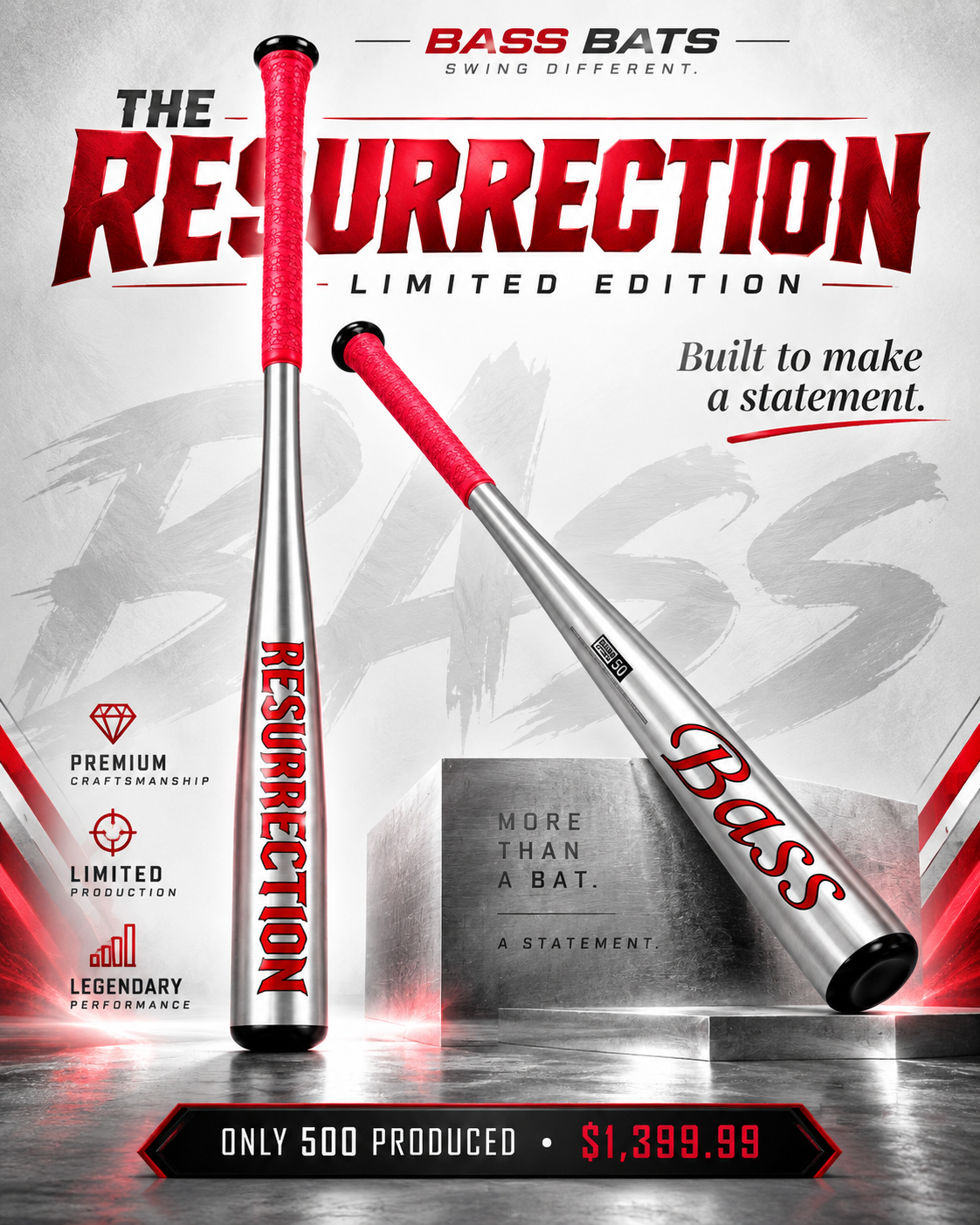
The Bass Bats RESURRECTION BBCOR (.50) is a one-piece alloy bat, BBCOR .50 certified for high school and collegiate play, with a 2 5/8 inch barrel and a -3 drop, and it needs no break-in period. It is listed in one size, 32 inches and 29 ounces, in a run fixed at 500 pieces. If a 32 is the length the hitter controls, it is a bat for the leagues in the table above that call for BBCOR; if the hitter needs a 31 or a 30, this is not that bat, and the record does not pretend otherwise.
Listed at 32 inches, 29 ounces. Bats are on BassBats.com.
Sources
- 01USSSA Official Baseball National By-Laws and Rules, 2026 edition, Rule 7.01.C (bat rules by age division)
- 02Little League: Bat Information (bats permitted by division)
- 03PONY Baseball: baseball bat rules
- 04Babe Ruth League 13-15 Division bat rules, as published by a chartered league
- 05NFHS Baseball Rules Book, Rule 1-3-2, as published by Baseball Rules Academy
Questions
- Can a 14-year-old use a -5 bat?
- Only where the league allows it. USSSA 14U moved to a -3 BBCOR national standard on January 1, 2026, with a state-level -5 exception; Little League Intermediate and Junior, PONY 14U and Babe Ruth still accept USABat-marked bats, which can be -5. High school play is BBCOR.
- Is a BBCOR bat too heavy for a 14-year-old?
- For some, at first. A 32 inch BBCOR weighs at least 29 ounces, three or more ounces up on a youth -5 of the same length. Size by control: a shorter BBCOR swung on time beats a longer one swung late.
- What length BBCOR bat for a 14-year-old?
- Most swing 31 to 33 inches, with 32 the common middle. The test is whether the hitter gets the barrel to the same spot on time at the end of a round, not a height chart.
- Does a 14-year-old need a BBCOR bat for high school tryouts?
- Yes. NFHS rules require BBCOR .50 for any bat that is not one piece of wood, and a freshman tries out under those rules.