
What BBCOR means
BBCOR stands for Batted Ball Coefficient of Restitution. It is a laboratory measure of how much of the ball's speed survives the collision with the bat: in the words of the laboratory that runs the test, "the ratio of the relative speed after impact to the relative speed before impact". A higher number means a livelier barrel.
The standard caps that number. Under the NCAA protocol, "the peak BBCOR must be less than or equal to 0.500", measured at the hottest spot on the barrel. That is the .50 on the certification mark. The point of the cap is to hold non-wood bats to roughly what a wood bat does: the laboratory notes that the BBCOR of wood bats is constant, whatever their length, and the limit was set around it.
Who has to swing a BBCOR bat
- College baseball. The NCAA adopted BBCOR as its bat standard for the 2011 season, replacing the earlier BESR test.
- High school baseball. The NFHS followed for the 2012 season. Rule 1-3-2 now reads that bats "not made of a single piece of wood shall meet the Batted Ball Coefficient of Restitution (BBCOR) performance standard".
- Leagues that adopt high school rules. Many 13-and-up travel organisations and some middle school leagues play under NFHS rules and require BBCOR. That is the league's decision, so read its bat rule before buying.
A BBCOR bat is not a youth bat. Youth leagues on the USA Baseball or USSSA standards use their own marks and allow lighter drops; a BBCOR bat carries neither mark. Wood-bat leagues and wood-bat tournaments are wood only, and a certified alloy or composite bat is not legal there either.
One change is scheduled. USA Baseball has published a USA BBCOR program, with bats carrying its mark eligible for NCAA play from the 2028 season. Its notice states the same physical limits (a 2 5/8 inch barrel, a drop no greater than -3, a length no more than 36 inches) and that bats carrying today's BBCOR .50 mark remain permitted. A bat bought now does not become illegal because of it.
How certification works
Certification is done on the bat, not on the brochure. Under the NCAA protocol every non-wood bat design is tested at Washington State University's Sports Science Laboratory: two samples of each length are submitted, one is fired at in an air cannon and measured, the other is kept as a "sister bat" in case of a later question. A composite barrel must also pass an accelerated break-in (ABI) test, so that a bat which gets livelier with use is still under the cap after it has been worked in.
A bat that passes may carry the mark. The NFHS rule is specific about it: the certification mark "shall be rectangular, a minimum of one inch on each side and located on the barrel of the bat in any contrasting color to read: 'BBCOR .50'", and it must be a silkscreen or other permanent mark - no label, sticker or decal is accepted. The NCAA protocol adds that bats produced after June 1, 2020 carry the mark and the model number 16 to 24 inches from the knob.
Certification is not permanent. The NCAA protocol gives a certification a fixed life of four or six years from the test, depending on the measured result, and the laboratory publishes decertifications when a model is found to exceed the limit. The approved-bat list at the Sports Science Laboratory is the record; an umpire can check it and so can you.
The rules of shape: 2 5/8, -3, 36
- Barrel
- 2 5/8 inches or less at the thickest point
- Drop
- -3 at most: the weight in ounces may not be more than three below the length in inches
- Length
- 36 inches or less
- Mark
- BBCOR .50, permanent, rectangular, at least one inch on each side, in a contrasting colour
NFHS Baseball Rules Book, Rule 1-3-2; the NCAA protocol verifies the same drop (W - L greater than -3.0) and a minimum moment of inertia during testing.
"Drop" is the length minus the weight. A 33 inch BBCOR bat weighs at least 30 ounces; a 32 inch bat at least 29. Because the drop is fixed at -3, choosing a length is choosing a weight, which is why length is the first real decision.
Length and weight: pick what the hitter controls
High school and college hitters mostly swing 31 to 34 inches. A longer bat adds plate coverage and moves mass away from the hands, which the hitter feels as a heavier swing even though the drop has not changed. The right length is the longest bat the hitter can get to the same spot, on time, with the same swing, at the end of a round of batting practice as at the start.
- Late on fastballs on the inner half with the current length: do not go longer.
- Consistently out in front, and reaching for pitches away: a longer bat may be the answer, but check the swing first.
- Height and weight charts were built for youth drops. At -3 they are a poor guide; swing weight and feel decide.
Two bats of the same length and weight can swing very differently, because what matters is where the weight sits, not how much of it there is. That is the next two sections.
One-piece and two-piece construction
A one-piece bat is a single length of material from knob to end cap. It is stiff, transfers energy directly and reports every contact back through the handle, which some hitters want and some find harsh on a mishit. A two-piece bat joins a separate barrel and handle with a connection piece, which allows the handle to flex and generally softens the feel of contact. Hybrids pair an alloy barrel with a composite handle.
Material matters as much as the join. An alloy barrel is at full performance the first time it is swung and needs no break-in. A composite barrel can need a break-in period and its makers often advise against use in cold weather. Neither is better in the abstract; a hitter who wants direct feedback and a bat that is ready in the wrapper leans one way, a hitter who wants a dampened feel leans the other.
Balanced or end-loaded
Swing weight describes where a bat's mass is. A balanced bat carries more of it toward the hands, so the barrel is easier to bring around and to adjust late in the swing. An end-loaded bat carries more toward the end, which gives a hitter with the strength to keep bat speed up more mass moving through the ball, at the cost of a barrel that is slower to start and harder to correct.
A contact hitter, a hitter still growing into a -3, and a hitter who struggles with off-speed pitching are usually better served balanced. A strong hitter who is already on time and wants more behind the ball can carry an end load. The label on the bat is a claim; the cage is the test.
Why feel decides
Every certified bat sits under the same performance cap, so the differences a hitter can actually feel - how quickly the barrel gets to the zone, how contact reports through the hands, how the bat sounds and sits at the top of the swing - are what separate one bat from another. Those are the things a hitter should choose by, and none of them is on the spec sheet.
- Swing it, in a cage or off a tee, for more than a few cuts. Fatigue shows what a first swing hides.
- Hit balls off the end and off the handle on purpose. That is where a one-piece and a two-piece part ways.
- Notice whether the hitter is early, on time or late with the same swing. Length and swing weight show up there before they show up anywhere else.
Choosing for the hitter, not the hype
- 01Confirm the league's bat rule. If it is NFHS or NCAA, the bat must carry the BBCOR .50 mark.
- 02Choose the length the hitter controls at the end of a round, not the longest one they can lift.
- 03Decide between direct feedback (one-piece, alloy) and a dampened feel (two-piece, composite) by hitting, including mishits.
- 04Choose the swing weight - balanced or end-loaded - by timing, not by reputation.
- 05Check the grip diameter and the knob in the hands. A grip that is too thin or too thick changes the swing more than most people expect.
- 06Verify the model on the certified list before the season, and again if a decertification is announced.
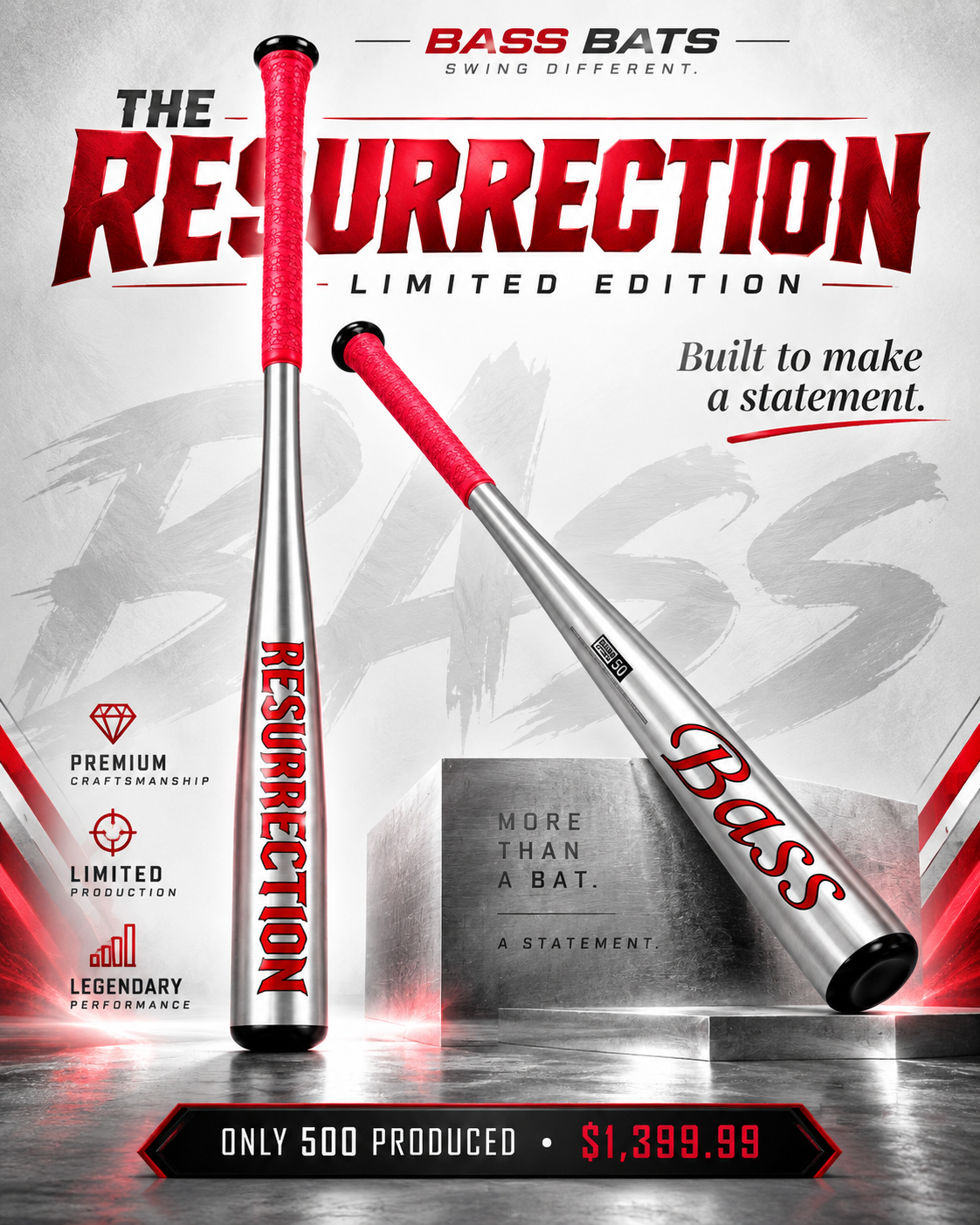
The current Bass release, with its recorded specifications and its fixed run.
Sources
- 01NCAA Standard for Testing Baseball Bat Performance (BBCOR Protocol), updated July 18, 2024
- 02Washington State University Sports Science Laboratory: approved bats and decertifications
- 03Washington State University Sports Science Laboratory: bat performance measures (BBCOR defined)
- 04NFHS Baseball Rules Book, Rule 1, Section 3 (bats), as published by Baseball Rules Academy
- 05USA Baseball: About USA BBCOR
Questions
- What does the .50 on a BBCOR bat mean?
- It is the performance ceiling. Under the NCAA protocol a bat's peak BBCOR, the measured ratio of ball speed after impact to before it, must be 0.500 or less. Every certified bat sits under that same number.
- Is a BBCOR bat legal in youth or Little League play?
- Generally no. Youth leagues use the USA Baseball or USSSA bat standards and their own marks. Some 13-and-up divisions and leagues that play by NFHS rules do allow or require BBCOR; the league's bat rule is the authority.
- Does a BBCOR bat need a break-in period?
- An alloy bat does not; it performs at full strength from the first swing. Composite barrels often do, and they are also tested after an accelerated break-in during certification. The Bass Resurrection is a one-piece alloy bat and needs no break-in.
- How do I check that a bat is still certified?
- Look for the permanent BBCOR .50 mark on the barrel, then check the model against the approved-bat list published by Washington State University's Sports Science Laboratory, which also lists decertified models.
- Why does every BBCOR bat have a -3 drop?
- The NFHS and NCAA rules require it: the weight in ounces may not be more than three below the length in inches. Because the drop is fixed, choosing a length is also choosing a weight, and the real differences between bats are in construction and swing weight.